

Managing Experience Through Integration: Building an Enterprise Journey System at Alaska Air Group
As Alaska Airlines and Hawaiian Airlines began a complex integration, the guest experience faced a structural challenge: decisions were moving simultaneously across policy, technology, airports, digital, loyalty, and operations, with implications that extended beyond individual functions.W
My role was to establish a journey-led management approach that made emerging guest risk visible earlier, connected fragmented experience signals, and brought customer impact into the executive routines governing integration.
An Enterprise Journey Strategy for Integration
Business Challenge
Traditional functional reporting could show what individual teams were changing. It could not always show what those changes meant when experienced together by a guest.
Journey satisfaction, sentiment, research, operational performance, pain points, and frontline insight existed across the organization, but operated largely as separate signals.
I established the guest journey as the organizing logic for integration: a shared enterprise frame for identifying cumulative impact, exposing dependencies across functions, and distinguishing necessary transformation tradeoffs from avoidable experience degradation.
Building the Sensing System
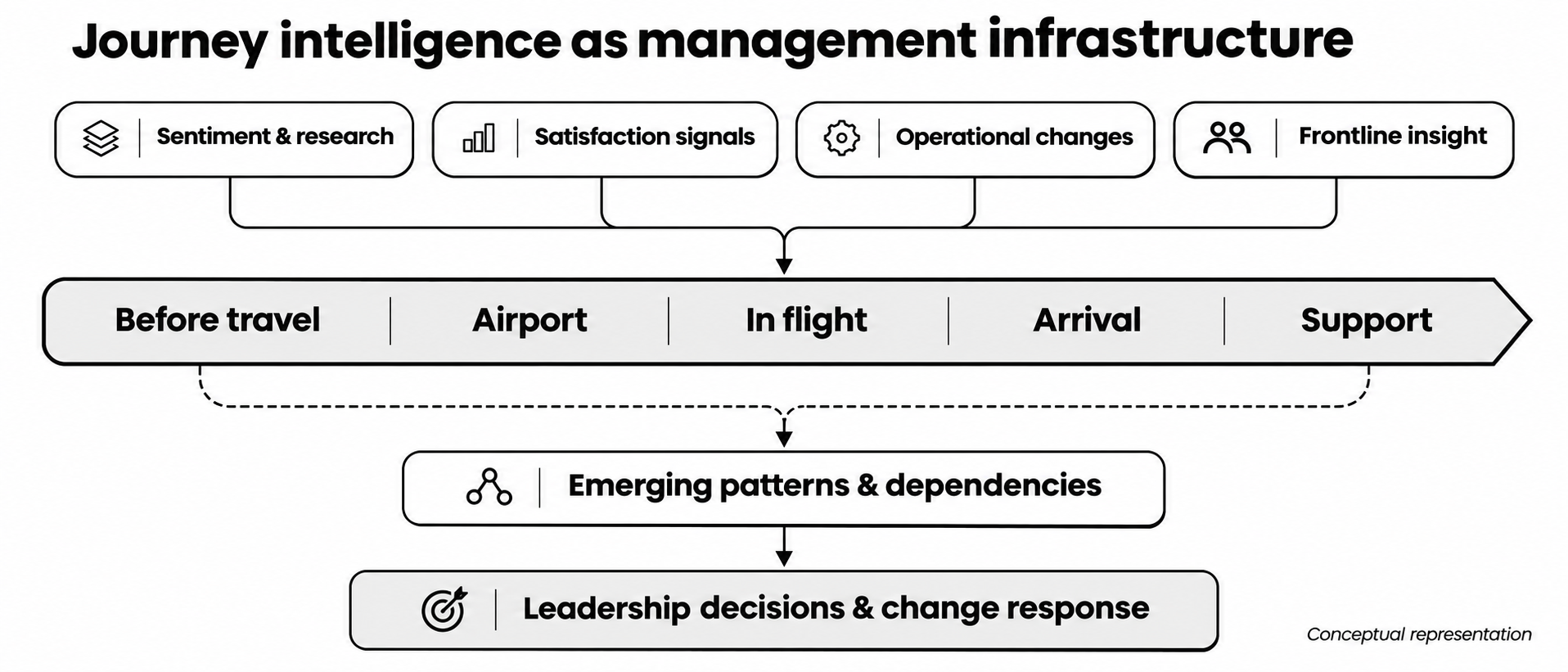
Working with my team and cross-functional partners, I built a shared journey architecture connecting maps, satisfaction, sentiment, research, operational changes, and known pain points.
We repositioned journey maps from static design artifacts into management infrastructure. They became a way to see where changes intersected, identify risks that no individual function could see alone, and understand how individually rational decisions could combine into a poor collective experience.
One example emerged in the approach to branding airport baggage service offices. A guest arriving from another airport, potentially on a differently branded flight, might encounter a service point whose identity did not match their travel experience.
At a particularly sensitive moment—seeking help for a missing bag—the priority was clarity about where to turn for support. Looking across the full journey rather than individual airport stations helped inform decisions about how guest assistance should be presented across the two airline brands.
The broader sensing system also allowed us to follow emerging guest narratives across integration, connecting signals that might otherwise appear unrelated.
For Hawaiian Airlines guests, changes to loyalty programs, branding, and technology were taking place alongside questions about how Hawaiian's distinct identity would be preserved. Individually, these changes could be understood as part of integration. Collectively, they could carry different meanings for guests navigating the transition.
The distinction between organizational intent and guest perception became critical. Understanding how guests interpreted change was as important as understanding the operational reasons behind it.
I brought that perspective into executive discussions, helping leaders consider not only what was changing, but how those changes might be experienced and understood.
Anticipating and Managing Change
The transition from airport check-in kiosks to bag-tag printing stations demonstrated how this intelligence could inform change management.
The new model required guests to adopt different behaviors, including checking in online rather than at the airport. Alaska's earlier experience with this transition provided a useful foundation for anticipating adoption friction.
For Hawaiian guests, the change also occurred within the broader context of integration. Guest response could be shaped not only by the practical adjustments required, but by perceptions of what the change represented.
Understanding these overlapping dimensions helped inform a cross-functional effort to communicate the transition and support guests as they adapted to the new process.
The sensing system also provided a way to monitor how the change was experienced, bringing together social conversation and guest feedback to distinguish anticipated challenges from the realities of the new airport experience.
This allowed the organization to consider both the concerns preceding a change and the experience of guests encountering it in practice.
The objective was not to prevent change. It was to anticipate its human consequences, prepare the organization to manage them, and understand what happened as guests adapted.
Embedding Experience Into the Business
Insight only matters if it reaches the places where decisions are made.
With executive sponsorship, I established and facilitated a governance forum focused on guest experience through integration. It created a recurring mechanism for bringing synthesized journey intelligence, emerging guest concerns, and cross-functional experience risks into leadership discussions.
I also integrated these insights into existing senior leadership and operational routines, connecting guest sentiment, research, journey performance, and operational change to the decisions shaping the integration.
Rather than reporting experience through separate functional lenses, this approach gave leaders a more connected view of what guests were encountering, how changes were interacting, and where intervention or additional attention might be needed.
This shifted experience intelligence from periodic reporting toward a recurring input into business decision-making.
Outcome
The work established an enterprise approach to managing guest experience through integration as a connected system rather than a collection of functional initiatives.
Leaders gained earlier visibility into cumulative journey risk, a shared language for evaluating customer impact across organizational boundaries, and recurring mechanisms for bringing that perspective into executive decision-making.
The approach informed cross-functional decisions, supported the anticipation and management of significant guest-facing changes, and strengthened the organization's ability to distinguish emerging concerns from observed experience.
For the organization, the shift was larger than better journey mapping or stronger insight. It changed the role of experience itself—from something measured after decisions were made to an input into how transformation was governed.
That created the foundation for a more deliberate form of integration: one in which the business could move quickly while retaining visibility into what those changes were asking of the guest.